
- Products & services Products & services
- Resources ResourcesCustomer resources
- Customer resources
- Customer support Find more information about engaging support and get help
- Services guide Find more information about working with Services teams
- Free resources Leverage our free tools and trainings
- Modernize to Identity Security Cloud Transition to the cloud for advanced capabilities and a future-ready security posture
Learning- Learning
- Identity University Get technical training to ensure a successful implementation
- SailPoint professional certifications & credentials Advance your career or validate your identity security knowledge
- SailPoint recertification program Get recertified by demonstrating ongoing learning
- Training onboarding guide Make of the most of training with our step-by-step guide
- Training FAQs Find answers to common training questions
- Community Community
- Compass
- :
- Discuss
- :
- Community Wiki
- :
- IdentityIQ Wiki
- :
- Azure Active Directory - Add most recent successful sign in to identity aggregation
Azure Active Directory - Add most recent successful sign in to identity aggregation
Azure Active Directory - Add most recent successful sign in to identity aggregation
Symptoms
We had a project that required the last sign in data from an Azure AD guest to allow us to perform life cycle events on the identity and any correlated accounts.
However, unlike Active Directory, Azure Active Directory doesn't store a last login time stamp in user attributes.
Solution
I have created an approach to obtain this and wanted to share with the community. Basically I created a rule that is triggered by a task to iterate all our user objects via the Microsoft Graph API which obtains the UPN, then we iterate the audit logs in Azure to find the last successful sign in for each UPN and store it in a Custom object which is used later on when the aggregation runs to insert the last login time stamp.
In addition the task prunes any UPN that doesn't exist in Azure from the Custom object (i.e. its been deleted) and retains the last sign in even when Azure AD drops it after 30 days.
We run this task on a daily schedule before the aggregations.
Attached is the Rule, Custom object and Customization Rule
Install steps:
1. Import XML objects through debug in ZIP attached
2. Create schema attribute in your Azure AD application called: "lastSignInSuccess"
3. Add the Customization Rule to your Azure AD application through the UI.
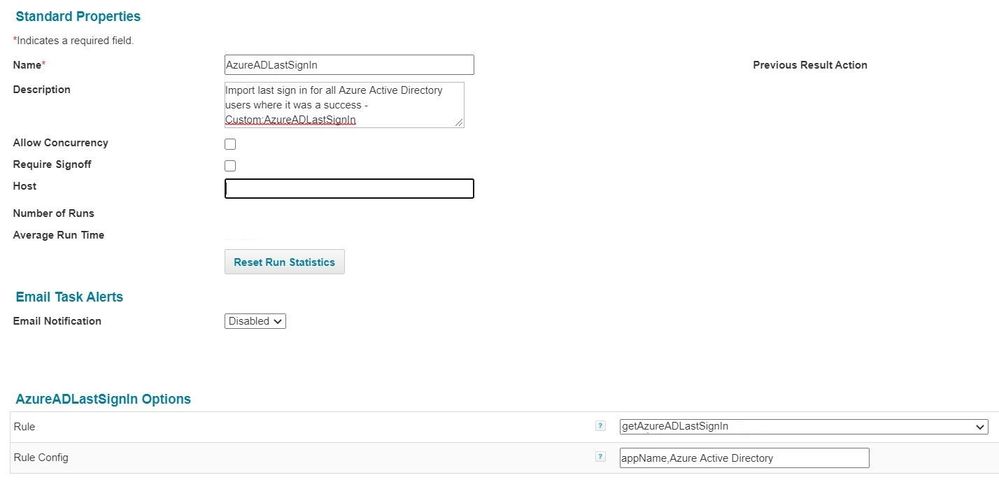
4. Create a new Task and use the "Run Rule" option
5. Structure your task as pictured, enter the name of your application in the rule config.
Any builds on improving this are welcome, hope this helps someone else please ensure you test this before moving to a production instance.
